Introduce
"Edongba" is a useful program to input Dongba hieroglyphs and Geba symbols which
are Naxi's language by English meaning or by Latian
alphabet for Naxi into your edit software on Windows
2000,Nt,2003,XP.
1.Background
In Southwestern China, East of the
first bend of the Yangtze River, set in a beautiful
valley, lies the town of Lijiang. Today there are
260,000 Naxi people living in Lijiang.
The Naxi language (a.k.a. Nakhi, Naqxi,
Nasi or Moso) is a Sino-Tibetan language, though some
linguists classify it as a Burmese-Lolo language.
Naxi has been written with Dongba script and Geba
script.
Dongba script
The Naxi Dongba script (a.k.a. Tomba
or dto-mba) is used exclusively by the Dongba (shamans/priests)
as an aid to the recitation of ritual texts during
religious ceremonies and shamanistic rituals.
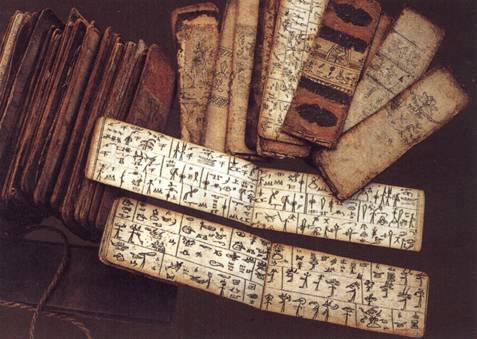
The Dongba priests wrote on coarse,
handmade paper. Sheets were sown together at the left
edge to form a book. Pages were ruled horizontally,
and the hieroglyphs were drawn from left to right
in three or five sections within the rules. Somewhat
thicker sheets of paper form a stiff cover that contains
the title. They were usually named after the type
of ceremony for which they were used.
These interesting symbols depicted
here are called Dongba Hieroglyphs, and represent
a unique form of writing, being in fact the only hieroglyphic
writing system still in use today. This writing system
of hieroglyphs has been recognized by international
academic and cultural circles as a most remarkable
world heritage. Naxi Dongba Hieroglyphs differ from
Chinese characters and may be compared to Egyptian
or Mayan hieroglyphs.
Naxi Dongba Hieroglyphs at first glance
resemble the hieroglyphics in the Book of Death of
ancient Egypt. They are, however, more sophisticated
and complete because they range from a system of symbols
to a complicated rebus with verbs, particles and phonetics.
The Naxi manuscripts are truly a "living
fossil" that still mystifies those that study
ancient Himalayan culture.
Geba script
The Geba script is structurally similar
to Chinese and contains a mixture of symbols derived
from Chinese characters, independently invented symbols
and simplified pictographs taken from the Dongba script.
As a Naxi person, I thought it very
important to develop a computer-based program to the
study and use the Naxi Dongba Hieroglyphs. I began
to design the software in June of 2000.Since completion
of the work, it continues to undergo constant improvement
and revision. It is now a highly user-friendly tool.
I named the software "Edongba".
2. Contents
2.1 Font
Edongba contains 1562 Dongba Hieroglyphs
and 661 Geba symbols in a True Type Font. These can
be enlarged or reduced distortion free.
Just like below:

2.2 Input Method
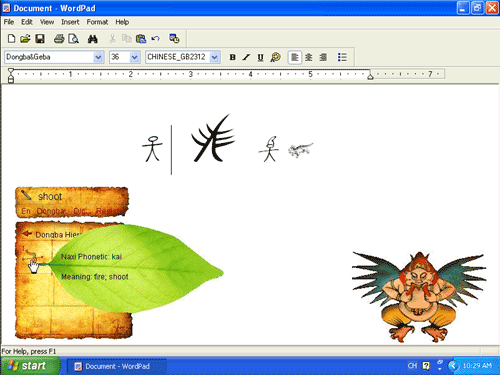
Use the input method you can input
Dongba Hieroglyphs and Geba symbols by English meaning
or Latin alphabet for Naxi into edit software ("Word"
, "WordPad"...). Please Click How to use to see more.
Or you can input Dongba Hieroglyphs and Geba symbols by Naxi Phonetic. You can find the Naxi Phonetic for each Dongba Hieroglyphs and Geba symbols in Dictionary of Edongba.
Consonants table:

Consonants table:

Consonants table:

3.Declare
Information in this document is subject
to change without notice. Complying with all applicable
copyright laws is the responsibility of the user.
No part of this document may be reproduced or transmitted
in any form or by any means, electronic or mechanical,
for any purpose, without the express written permission
of Xiaohui Yang.
Xiaohui Yang may have patents, patent
applications, trademarks, copyrights, or other intellectual
property rights covering subject matter in this document.
Except as expressly provided in any written license
agreement from Xiaohui Yang, the furnishing of this
document does not give you any license to these patents,
trademarks, copyrights, or other intellectual property.
(c) 2001 Xiaohui Yang. All rights
reserved.
4.Thanks
(1). In developing a reliable and
accurate system, I based much research and content
on "Naxi Hieroglyphs Zipu," written by Professor
Guoyu Fang and Zhiwu He.
(2). I have been assisted by Shihong
Zhao, Jingsheng Li and ShiYing Wang, they are scholars
of Dongba Cultural Research Institute in the Chinese
province of Yunnan, the town of Lijiang.
|